One more story Monday, March 19, 2007
There was one more story I wanted to share from yesterday ...
As the march worked its way past Pioneer Courthouse Square, there was a group of eight people in orange jumpsuits with black sacks over their heads lying down in the middle of the street, all chained together in some kind of public expression. There was an older lady walking around them, spreading Jesus' blessing on them. I don't know if she was part of the group, or just acting on her own.
Nevertheless, I started photographing them as the protesters marched around them. So far, so good.
But then a guy told me that the shot "I" wanted was from a different angle. I stopped and started talking with him. When I asked his name, he hesitated, so I had to explain that I needed to caption the photos, so I needed some kind of a name to attach to them. He identified himself as "Lucas Personality," although I have to admit I'm not sure whether that was what he called himself or some company he was representing. He said something about trying to cast people for NBC/Universal or something ... I started getting the picture that the jumpsuit people were more of a stunt than a protest. He suggested I try to submit my pictures to Reuters or NBC.
Meanwhile, the protest was moving on and I needed to stick with it. Rather than talk with him for another 20 minutes, I gave him my business card, and suggested he email me with the details of who he and the group were, what they were trying to say, etc. I moved on, figuring that was the end of it.
He rewarded me with a phone call at 5:15 this morning. The first thing he asked was "did I wake you up?" Dude, it's 5:15 a.m. ... what did you think I'd be doing? And he called from a local number—it's not like he was in New York.
He asked if I wanted to sell my images, and told me I'd have to send them off before I went to work this morning; I could call 411 to get the number for Reuters, and I should let them caption the photos. I re-suggested that he email me the information. After telling me that he didn't have a computer handy, he confirmed my address and pretended to start an email: "Let's see ... compose ..."
I haven't seen an email yet ... and I'm not inclined to publish the photos, on this blog or anywhere else.
Anti-war demonstration in Portland
I haven't figured out what I want to say about yesterday's events yet, so I'll just post the pictures. Maybe I'll add more later. The "zombie" feeder march (which did not have a permit) attracted more police than protesters—at their announced kick-off time, there were 11 cops for 5 protesters, only one of whom was dressed as a zombie.
By the time they turned south from Burnside towards the gathering point for the main protest, there were about 9 protesters and 18 police; the protesters had also collected three citations for jaywalking. Most of the estimated 10,000 to 15,000 protesters looked something like these. There were babies and dogs, teens and grandparents.
 A group of about 200 "radical" protesters dressed in black and wearing bandanas co-opted the front of the march. Before it kicked off, they did some unspeakable acts as shown in this photo, too edgy for the mainstream press.
 Organizers had intended the front of the march to look something like this.
 Instead, it looked like this (left).
It seems that, after the anarchists had taken over the front of the parade, the organizers and/or police intended to let them move on a block or two ahead of the main march. About four blocks into the march, the radicals realized what was going on, so they turned around to rejoin the parade. The police quickly directed the main march on a slight detour, and the radicals were stuck somewhere in the middle. After a while of walking with the radicals in the middle of the parade, I moved up to the front to get some shots of that group. Then I noticed that a bit of a gap had opened up between the mainstream front of the parade and the anarchists. As I headed back to the group, something happened that set the group off. When I got close enough to see, the police were separating an older, long-haired man from the crowd. I don't know why. But the anarchists clearly disapproved, shouting "this is what a police state looks like!" and throwing rotten fruit from somewhere behind the front line. I can only presume that the fruit was aimed at the police; nevertheless, I took three direct hits from rotten oranges. I think they only threw four. Fortunately, rotten fruit is soft, and my gear was basically uncontaminated. As one photojournalist commented to me after the incident, that's how you know you're in the right place.
 Make no mistake about it, these "radicals" or "anarchists," or whatever they want to call themselves, are looking for an opportunity to clash with the police. Most wear bandanas or masks to conceal their identity. As well as the rotten fruit that some "just happened to have on hand," some came equipped with gas masks; others wore lab goggles to protect their eyes. Some self-described 'medics' carried water and some other concoction to neutralize pepper spray or tear gas.
More interesting was the way that these 'medics' used the word as a verb, as in "Yeah, I'm going to medic this afternoon because I already got a jaywalking ticket." What they had been planning to do remained unstated ... but of course the police must have provoked it.
I left the rally as the march returned to the South Park Blocks so that I could file my pictures. Apparently, I left too soon. The people I had been following all day burned their flags. Shortly thereafter there was an incident at SW Morrison and Park where the police used pepper spray, then a group of protesters surrounded the Justice Center in a standoff that lasted well into the evening. Fifteen were arrested. Just like that, my images became (almost) worthless ...
Pro-Choice supporters rally on anniversary of Roe v. Wade Monday, January 22, 2007
 Pro-Choice supporters rally in Portland, Ore., on Jan. 21, 2007. With chants of "Not the church, not the state, women should decide their fate," more than 50 people made the short march from Shemanski Fountain to First Unitarian Church in downtown Portland. The event was organized by the Pro-Choice Coalition of Oregon to commemorate the anniversary of the Roe v. Wade decision, which was handed down on Jan. 22, 1973.
How to stage an effective protest Tuesday, November 21, 2006
For today's protest du jour, we have the Oaxaca situation again. You may remember that I posted a couple of weeks ago about two protesters who had locked themselves to the door of the Mexican Consulate in Portland. Yesterday (Nov. 20) they were at it again. Except this time it wasn't anywhere near as dramatic. In fact, I have to say, that it was one of the least interesting protests I've had the chance to photograph. With that in mind, this posting presents a few tips for those would-be protesters for making their demonstration effective, at least from a photographic point of view.
The point of most protests is to get a message across to the powers that be. Obviously, if you're protesting in front of, say, the Mexican Consulate, you want the people inside to know you're there. Maybe there were a dozen people inside. If you're lucky, they'll mention it in a report to their bosses at the embassy. And maybe a couple hundred people will walk by your event as you demonstrate, so you get them. But thousands will read the newspaper or watch the television news. If you can get those people onside, then your message has power. And the people inside the consulate will have a clipping they can send to their bosses at the embassy.
So what am I looking for in a news photo? As well as all of the technical and aesthetic elements that make a good picture, I need three things: a distinct group people (usually passionate), a message, and a target. And remember that most news stories only get one photograph, so I need all of those in one image.
Now, before anyone gets all uppity, remember that these are just the opinions of one photographer. I know that it's my job to make a storytelling image of whatever is thrown in front of me, regardless of the situation. I take pride in my ability to do that despite all the cards that are stacked against me. And I would never actually give suggestions to any subjects of a news photo—that would be unethical as I'm there to document what happens, not influence it. But these are some of the things that pass through my mind as I'm trying to capture a Pulitzer-prize winning image, or at least something that fairly represents the events I see. "Geez, I wish they would just ..." or "Aren't they going to do something?"
 Get the necessary permits. Yesterday's protest got off to a muted start because the group didn't have a permit to gather in Pioneer Courthouse Square. Yeah, I know they cost money, and you don't want to feed the system you're trying to fight against. But face it, like it or not, those guys are in charge. If you try to circumvent their rules, they'll shut you down right quick. That's not my problem; if it happens, I'll photograph that. But if you follow their rules and manage to beat them, it's an undeniable victory. At right, Sgt. Fender of the Portland Police Bureau explains the limits of what the group can do without a permit to one of the protest organizers.
- Be organized. Admittedly, organizing anarchists is like herding cats. But protests aren't very effective when everybody is just standing around trying to come up with another chant to yell, or trying to figure out what route to take on the march.
- Get lots of people. Yes, you can make up for small numbers with enthusiasm, but that only goes so far. I don't care how passionate you are, systematic inhumane treatment of dust mites isn't newsworthy. One of the main criteria for whether something is newsworthy or not is whether people care. In a city of 1 million+, if you can only attract 30 people to your protest, that's an indication that your cause doesn't impact on that many people. I understand that a fire starts with a single spark. But a lot of sparks don't start fires at all. Call me when you've got a fire.
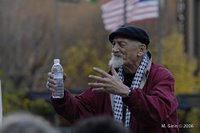 Most protests include a chance for group leaders to speak to the gathered crowd. I want to photograph their faces as they speak. But I also need something in the background that represents the cause, or what you are protesting. That would happen naturally if the speakers speak from the middle of the group, so that there are protesters and/or signs behind them. At least have a banner or something behind them. Otherwise, they just look like street corner preachers (see at right). Not newsworthy.
- If you don't have lots of people, at least stick together. Unless it is symbolic of your cause, a thinly dispersed group of people "doesn't read well." That is, it's hard to convey the image of a group of people united for a cause. If everybody's wearing similar clothes or has the same hat or something, that also helps to visually unite the group.
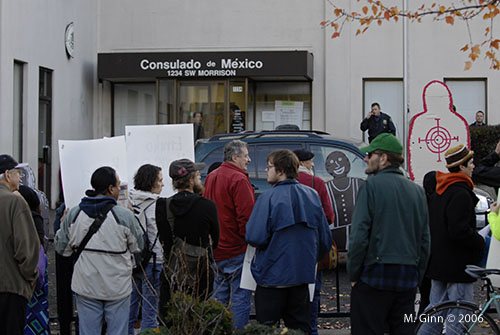
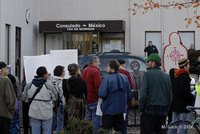 Have signs, lots of signs, and make them two-sided. Remember, photographs are visual things. For the most part, one group of people yelling and shaking their fists looks the same as another. So if you want your message to get across in print, you need some kind of recognizable symbol in the picture. I'm not suggesting that you should walk up to the photographer and show them your sign, but if you're there waving it about, you want to give the media a chance to capture it. Making two-sided signs helps. In the photo at right, for example, you can see a (thin) bunch of people in front of the Mexican Consulate in Portland. There's a cop in the background. They have signs, but most of them are facing the consulate. I understand that these people were picketing the consulate, and wanted to get a message to the people there. But if you have two-sided signs, then the people reading the paper will get your message too. Which is the more important audience—the dozen people inside who couldn't change anything if they wanted to, or the thousands who will read the newspaper? Why don't I just photograph the front of the people, you ask?
 Three reasons: First, I need to get some kind of location in the picture, so people will know you're outside the Mexican Consulate, or at the Police Chief's house, or whatever your target is, and not just standing on the beach. Second, the police won't let me stand on private property any more than they allow the demonstrators to. Finally, I did, as best I could (see photo above).
- Use symbols that people know, and keep them simple and clear. Originality is great, but remember that the average reading time for a newspaper photograph is something less than a second. So it's got to be pretty obvious. If the reader (who probably doesn't know much about your cause) doesn't immediately understand the message, they will pass right by it. And if they don't read the picture, they won't read the story.
- Some of the most effective protests include some kind of performance that symbolizes your message. Acting out something or setting up a dramatic tableau that represents your cause makes for a good photo op. I don't want to suggest pulling any stunts that would get you arrested but, frankly, that had a lot to do with why the last Oaxaca protest made the news and yesterday's didn't.




 Posts


